Impressions: The Peak of Modal Minimalism
Impressions is John Coltrane's definitive modal anthem, a composition that strips jazz down to its most essential elements: rhythm, melody, and a single, unchanging mode. Released on the iconic 1963 live album of the same name, it follows the exact same 32-bar AABA structure as Miles Davis's 'So What,' but with a more aggressive, high-energy attitude. It is a piece that prioritizes stamina, creativity, and the exploration of a limited harmonic space. The song's title is fitting, as it allows the soloist to create a myriad of 'impressions' over a static D Dorian and Eb Dorian landscape. There are no chord changes to hide behind, no functional resolutions to provide direction. Instead, the musician is forced to rely entirely on their own melodic logic and rhythmic invention to sustain interest over extended periods. It is the ultimate test of an improviser's ability to 'create something from nothing.' From a technical perspective, Impressions is a masterclass in modal stability and 'side-slipping.' It demonstrates how a simple shift of the entire modal plane by a half-step can create a powerful sense of tension and release. For the student of jazz, describing Impressions is about recognizing the moment when 'modal jazz' moved away from the cool, meditative state of 'Kind of Blue' and toward the fierce, searching intensity of Coltrane's classic quartet.
Introduction: A Tonal Landmark
Analyze the harmonic innovation and cultural impact of Impressions. This composition serves as a foundational study in High-speed modal improvisation and the use of 'side-slipping' as a tension tool..
Historical Context
Coltrane based the melody of Impressions on a theme by the classical composer Morton Gould, as well as several riffs he had been experimenting with since his time with Miles Davis. The recording from the Village Vanguard in 1961 is the definitive version, featuring a relentless, nearly 15-minute solo by Coltrane that pushed the boundaries of what was considered 'acceptable' in jazz at the time. It marked a significant step toward the 'free' and 'avant-garde' experiments of his later years. Historically, the tune represents the engine room of the John Coltrane Quartet. With McCoy Tyner's powerful quartal piano, Jimmy Garrison's steady bass, and Elvin Jones's polyrhythmic drumming, Impressions became a high-octane vehicle for spiritual and musical exploration. It showed that modal jazz didn't have to be 'cool'; it could be as burning and technically demanding as any bebop tune, provided the musicians had the stamina and vision to sustain the energy. Today, Impressions is a staple of the jazz repertoire and a mandatory study for any serious saxophonist or improviser. Its historical significance lies in how it popularized the 'Coltrane style' of modal playing—characterized by dense, 'sheets of sound' runs and a deep, blues-inflected intensity. It remains a symbol of the creative freedom and relentless searching that defined the jazz avant-garde of the early 1960s.
Interactive Soloing Laboratory
Use the buttons below to visualize key harmonic moments on the fretboard and circle of fifths.
Harmonic Deep-Dive
Harmonically, Impressions is identical to 'So What.' It consists of 16 bars of D Dorian, 8 bars of Eb Dorian (the bridge), and then a final 8 bars of D Dorian. There are no functional chord changes, no ii-V-I cadences, and no traditional resolutions. The entire harmonic narrative is driven by the shift from the home mode up to the 'remote' Eb Dorian and back again. This 'static' harmony requires a different analytical approach. Instead of looking at how chords lead to one another, we look at the internal relationships within the mode. The 6th (B natural in D Dorian) and the 9th (E) become the primary 'color notes' that define the sound. The soloist must find ways to create tension within this stable environment, often by using 'side-slipping'—temporarily playing notes from a different mode (like Eb Dorian or B Major) to create a 'rub' before resolving back to the home mode. For the theorist, Impressions is the ultimate study in modal economy. It demonstrates how a single mode can support an infinite range of melodic and rhythmic ideas. The 'tension' isn't in the chords; it's in the soloist's relationship to the tonal center. Mastering this piece means learning how to be the master of your own harmonic destiny, choosing when and how to create tension without the help of the composer's structure.
D m7 Chord
Intervals: root, b3, 5, b7
Eb m7 Chord
Intervals: root, b3, 5, b7
Recommended Resources for Impressions
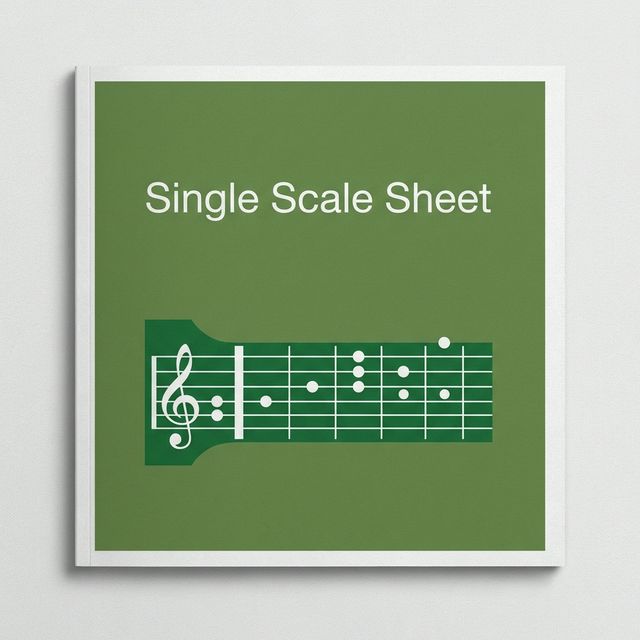
Sheet: D Ionian (Major)
$5
Sheet: D Dorian (Major)
$5
Sheet: D Phrygian (Major)
$5
Sheet: D Lydian (Major)
$5
Sheet: D Aeolian (Major)
$5
Sheet: D Locrian (Major)
$5
Sheet: D Blues major
$5
Sheet: A Minor
$5
Sheet: A Blues minor
$5
Sheet: E Minor
$5
Sheet: E Blues minor
$5

Bundle: All D Chords
$25
Bundle: All D Arpeggios
$25
Bundle: All D Scales
$25
Melodic Analysis
The melody of Impressions is simple and declarative, built from two short, syncopated motifs. The first motif is a rising 4th, while the second is a descending scale run. This motivic simplicity is intentional; it provides a clear, recognizable 'signpost' for the listener before the soloist launches into the deep modal exploration that is the heart of the song. The melody isn't the main event; it's the invitation. In the solos, the melodic approach is dense and searching. Unlike Miles Davis's sparse lines on 'So What,' Coltrane used Impressions to showcase his 'sheets of sound'—rapid, cascading runs that explore every possible permutation of the Dorian mode. This density provides the musical 'weight' that replaces the missing harmonic complexity. The melodic lines often feature wide intervals and angular leaps, creating a modern, aggressive sound that distinguishes it from more traditional jazz themes. For the interpolator or soloist, the melody provides a baseline for motivic development. By taking the simple 'rising 4th' motif and experimenting with its rhythm, placement, and interval size, a soloist can create a cohesive statement that stays true to the song's high-energy heart. The melody teaches the importance of a clear theme in a piece that is otherwise wide open, providing a necessary 'anchor' for both the performer and the audience.
Rhythmic Foundation
The rhythmic foundation of Impressions is a fast, aggressive, and relentless swing pulse. Unlike the relaxed feel of 'So What,' Impressions is typically played at blistering tempos, often reaching 260 BPM or higher. The rhythm section's job is to provide a 'wall of sound' that is both incredibly stable and polyrhythmically active. It is a groove that demands immense physical stamina and mental focus. Jimmy Garrison's bass provides the primary 'walking' line, which must be rock-solid to allow the other musicians to experiment. Elvin Jones's drumming on this track is legendary; he uses a dense, rolling cymbal pattern and frequent, unpredictable snare and bass drum accents to create a shifting rhythmic landscape. This 'circular' and 'active' rhythm is the secret to the Coltrane Quartet sound, providing a sense of constant, explosive energy. Maintaining this intensity during a long solo is one of the greatest challenges in jazz. It requires the band to move as a single, unified unit, reacting to every dynamic shift and melodic suggestion from the leader. For any ensemble, mastering the Impressions rhythm is a vital step in learning how to play high-energy modal jazz and how to use the rhythm section as a powerful, interactive engine of musical search.
Improvisation Strategies
Soloing over Impressions requires a 'horizontal' mindset and a high level of technical facility. For the D Dorian sections, use the D Dorian scale as your baseline, but expand into 'pentatonic substitutions' to add modern color. For example, playing the A minor pentatonic over D Dorian highlights the 9th and 11th, while E minor pentatonic highlights the 9th, 6th, and 7th. This 'stacking' of pentatonics is a key part of the modern modal sound. The bridge (Eb Dorian) is your chance to use 'side-slipping' to create maximum tension. Try taking a motif you've been working on in D and immediately transposing it to Eb. This provides a clear, structural 'jump' that the listener can follow. As the speed increases, focus on long, flowing 8th-note streams that explore the full range of your instrument, using enclosures and chromatic passing tones to bridge the gaps between the modal tones. Finally, use rhythmic variation and dynamic shifts to build your solo. In a piece with so few chord changes, the 'arc' of your solo is entirely in your hands. Start with simple, motivic ideas and gradually build the density and speed until you reach a climax of 'sheets of sound' runs. Use silence as a tool to reset the listener's ear before launching into a new idea. Your goal is to be a 'melodic architect,' building a complex and beautiful structure over the foundation of Coltrane's simple, two-mode landscape.
Key Takeaways
The primary takeaway from Impressions is the mastery of high-speed modal improvisation. After learning this tune, you will have the stamina and vocabulary needed to solo over static harmonies for extended periods without becoming repetitive. It builds the 'mental endurance' and creative vision required for modern jazz and fusion performance, teaching you the value of finding Depth within Simplicity. Secondly, the tune is the quintessential study in 'pentatonic stacking' and 'side-slipping.' These are foundational techniques for the modern jazz soloist, allowing you to create complex, 'outside' sounds while remaining connected to a single tonal center. This lesson in harmonic expansion is invaluable for any musician looking to evolve their sound beyond traditional bebop. Finally, Impressions is a lesson in 'spiritual and creative intensity.' It represents the uncompromising, searching spirit of John Coltrane's music. By learning this piece, you connect with a legacy of musicians who used jazz as a vehicle for deep personal and artistic search. It is a reminder that in the right hands, two modes can be a gateway to an infinite world of musical expression and discovery.
© 2026 Sheets Media Academy. All Rights Reserved.