Bluesette: The Whimsical Waltz of Toots Thielemans
Bluesette is a charming and whimsical jazz waltz composed by the legendary harmonica player and whistler Toots Thielemans in 1962. It is distinctive for its 3/4 time signature and its light, infectious melody that blends sophisticated jazz harmony with a folk-like lyricism. It has become a worldwide favorite, appearing in countless film scores and becoming a mandatory standard for its unique 'harmonic bounce.'
Introduction: A Tonal Landmark
Analyze the harmonic innovation and cultural impact of Bluesette. This composition serves as a foundational study in Jazz Waltz (3/4) and sequential ii-V progressions..
Historical Context
Originally featuring Toots whistling and playing guitar simultaneously, Bluesette became an international hit. It broke the mold of the standard 4/4 jazz tune, proving that a waltz could be just as swinging and sophisticated. Historically, it reflects the more melodic and 'easy-going' side of European-influenced jazz that gained popularity in the early 1960s.
Interactive Soloing Laboratory
Use the buttons below to visualize key harmonic moments on the fretboard and circle of fifths.
Harmonic Deep-Dive
The harmony is characterized by long sequences of ii-V-I progressions that move downward in whole steps, similar to 'Afternoon in Paris.' In the key of G, it moves through Gmaj7 to F7 to Bbmaj7 to Eb7 to Abmaj7, etc. This 'cascading' effect creates a sense of constant, graceful motion that perfectly matches the 3/4 time signature.
Gmaj7 (I)
Intervals: root, 3, 5, 7
F7 - Bbmaj7 (Sub)
Intervals: root, 3, 5, b7
Em7 - A7 (ii-V)
Intervals: root, b3, 5, b7
Recommended Resources for Bluesette
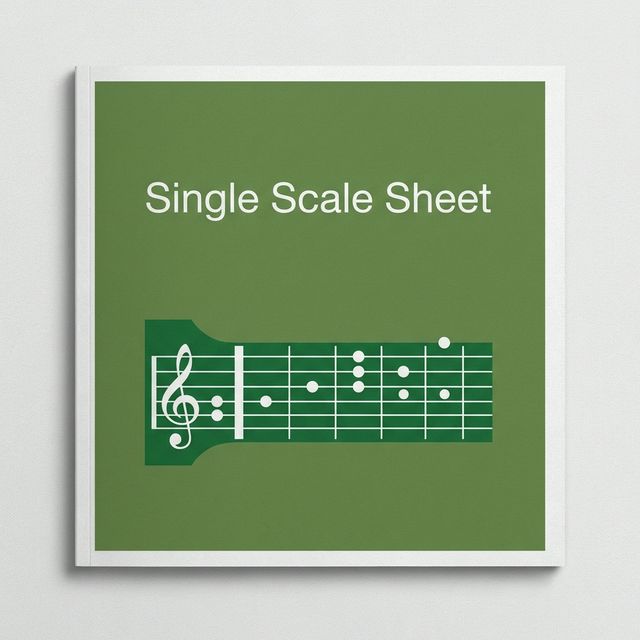
Sheet: G Ionian (Major)
$5
Sheet: G Dorian (Major)
$5
Sheet: G Phrygian (Major)
$5
Sheet: G Lydian (Major)
$5
Sheet: G Aeolian (Major)
$5
Sheet: G Locrian (Major)
$5
Sheet: G Blues major
$5
Bundle: All G Chords
$25
Bundle: All G Arpeggios
$25
Bundle: All G Scales
$25
Melodic Analysis
The melody is famously catchy and lyrical, often described as 'whimsical.' It relies heavily on sequences and simple scale runs that outline the underlying chords. Its 'sing-along' quality is what has made it such a popular crossover hit, appealing to both hardcore jazz fans and general audiences alike.
Rhythmic Foundation
As a 3/4 waltz, Bluesette requires a light, dancing pulse. The rhythm section should focus on the 'one' while maintaining a steady eighth-note flow. The drums often use brushes to create a soft, 'shuffling' feel that enhances the song's gentle character. The pulse should feel like a graceful swirl rather than a heavy march.
Improvisation Strategies
Soloing in 3/4 requires a different rhythmic mindset—focus on groups of three and avoid the standard 4/4 'clichés.' Use the sequential nature of the changes to build 'liquid' phrases that flow across the bar lines. The G major scale is your home, but be prepared to follow the rapid modulations using simple guide-tone lines.
Key Takeaways
The primary takeaway is the mastery of the jazz waltz feel and the ability to navigate rapid, sequential modulations. It teaches you how to maintain melodic elegance in a non-standard time signature. Additionally, it highlights the power of 'charm' and 'lyricism' in jazz composition.
© 2026 Sheets Media Academy. All Rights Reserved.